


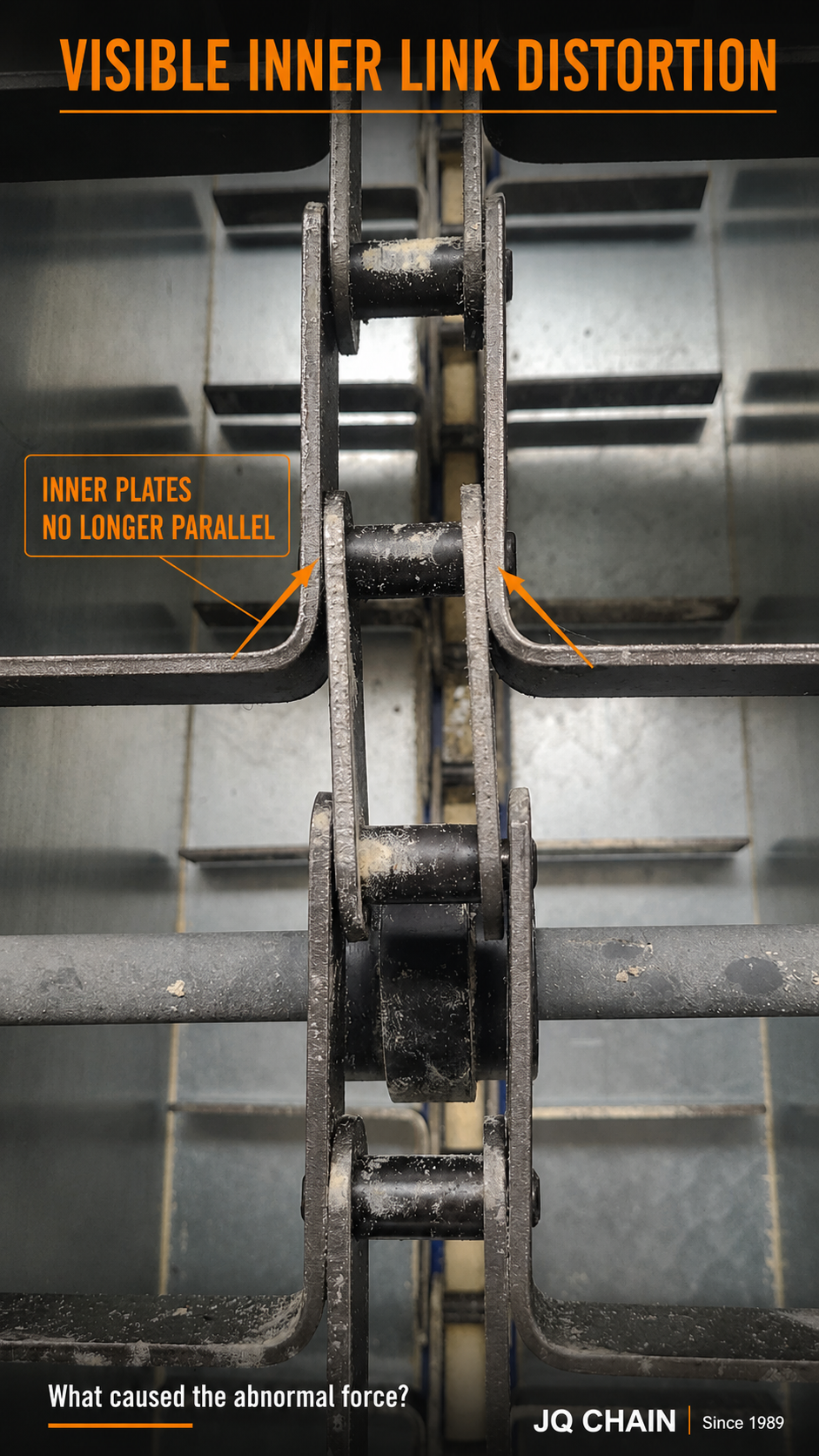
When inner link plates in a conveyor chain become visibly twisted or no longer remain parallel, the deformation should be treated as evidence—not as a final diagnosis.
In one grain-handling case, visible distortion appeared after the chain had handled only around 100 tons of material. One of the first questions was whether the bushes had been pressed too tightly into the inner link plates during assembly. It was a reasonable question to investigate, but not enough to determine the cause.
The 100-ton figure provides useful background, but cumulative tonnage alone does not describe the actual severity of the operating conditions. Peak chain tension, shock loads, starts and stops, blockage events, and operating cycles may all matter when investigating early deformation.
What Does a Twisted Inner Link Tell Us?
Visible twisting indicates that the link has undergone permanent deformation. What it does not tell us immediately is where that deformation originated.
Possible contributors can exist on both the chain and conveyor sides. They may include dimensional or assembly irregularities, restricted joint articulation, excessive tension or overload, installation damage, sprocket or guide misalignment, insufficient clearance, interference with surrounding components, or localized material blockage.
This is why the deformation pattern itself is useful evidence. The location of the affected links, the direction of twisting, whether the problem repeatedly appears in the same conveyor section, and any unusual contact or wear marks can help narrow the investigation.
What Should Be Checked Around the Bush and Joint?
The bush-to-inner-plate fit and the pin-to-bush articulation should be treated as two different issues.
In many conveyor chain designs, the bush is intentionally press-fitted into the inner link plate. A press fit itself is therefore not evidence of a defect. The relevant questions are whether the fit and assembly condition are within the intended specification, whether the bushes are seated consistently, and whether pressing has introduced plate distortion or dimensional irregularity.
Joint articulation should then be checked separately at the pin-bush interface. Restricted movement, seizure, insufficient lubrication, contamination, or foreign material around the joint can prevent normal articulation and introduce additional loads into the chain. Tsubaki’s large conveyor chain troubleshooting guidance identifies improper installation, insufficient lubrication, foreign matter, and excessive loading among conditions that should be investigated in conveyor-chain problems.
Useful chain-side checks therefore include:
• Bush seating and assembly condition;
• Plate parallelism and geometry;
• Pin-bush articulation;
• Unusual wear, scoring, or contact marks.
Why Should the Conveyor Be Inspected Too?
Even when a chain is manufactured and assembled within its intended specification, abnormal forces can still arise if the surrounding conveyor does not allow it to run as intended.
Misalignment, side pressure, guide conditions, inadequate clearance, and interference with surrounding structures can change how forces are transmitted through a conveyor chain. Tsubaki’s installation and maintenance guidance also recommends checking that the chain path is free from obstructions, that the chain does not contact the casing, and that articulation remains smooth during operation.
For this reason, the conveyor-side inspection should focus on a few practical areas:
• Sprocket and guide alignment;
• Clearance around the chain and attachments;
• Rubbing, scraping, or other contact marks;
• Material or debris accumulation that could restrict movement;
• Local interference or blockage points;
• The location of damaged links relative to transfer, drive, return, or take-up sections.
If deformation repeatedly appears after the chain passes through one particular area, that location deserves close attention. But the pattern alone should not be treated as proof of the cause; chain assembly, installation, and operating conditions still need to be evaluated together.
Inspect the Chain and Conveyor as One System
The objective of a root-cause investigation is not to decide as quickly as possible whether the chain or the conveyor is responsible.
The chain, sprockets, guides, structure, material flow, and operating conditions interact. A twisted inner link may result from one factor or from several conditions acting together.
Any chain link showing permanent deformation should be assessed before continued operation. Before replacing damaged parts or changing the chain design, the more useful question is:
What created the abnormal load or constraint in the first place?
Finding that answer is what helps prevent the same deformation from appearing again.


