When designing or maintaining industrial equipment, selecting the correct type of chain is critical for performance, safety, and cost-effectiveness. Two of the most common types encountered are roller chains and leaf chains. While they may look somewhat similar at a glance, they are engineered for fundamentally different purposes. Understanding their differences is key to optimal machinery design and avoiding premature failure.
This article will break down the distinction between these two power transmission components.
Fundamental Difference: Transmission of Power vs. Withstanding Tension
The most straightforward way to differentiate them is by their primary function:
- Roller Chain: Designed to transmit power efficiently between two or more shafts via sprockets.
- Leaf Chain: Designed primarily for lifting, pulling, and tension-bearing applications, often in hydraulic cylinders or linear actuators.
This core functional difference dictates their unique designs, which we will explore below.
A Side-by-Side Comparison
| | | Leaf Chain (e.g., Jinqiu LL Series) |
| | | Load Suspension / Linear Motion |
| | Inner & outer link plates, pins, bushings, rollers | Multiple, identical leaf links stacked together, pins |
| | More complex, with articulated rollers that engage with sprocket teeth. | Simpler, consisting of parallel steel plates held together by pins. No rollers. |
| | Rolls smoothly onto sprockets, minimizing friction and wear. | Does not run on sprockets for power transmission. It articulates at the ends, functioning like a "tension bar" with pivoting points. |
| | Strong, but designed for torsional (power) strength. | Exceptionally high tensile strength. Built to withstand massive static and dynamic loads in a straight line. |
| | Conveyors, motorcycles, agricultural machinery, industrial drives. | Forklifts, cranes, lifts, excavators, hydraulic rams, balers. |
Detailed Analysis of Each Chain Type
1. Roller Chain: The Power Transmission Workhorse
A roller chain's sophisticated design is what makes it efficient for power transmission. The rollers act as bearings, rolling onto the sprocket teeth as the chain engages. This reduces friction and wear compared to a simpler chain sliding directly onto the sprocket. High Efficiency: Low friction loss during power transmission.
High-Speed Capability: Suitable for applications with high rotational speeds.
Reliability: Proven design for a wide range of industrial uses.
Typical Applications: Any equipment where rotational power needs to be moved from one place to another, such as packaging machinery, conveyor systems, and drive systems in vehicles.
2. Leaf Chain: The Heavy-Duty Tension Master
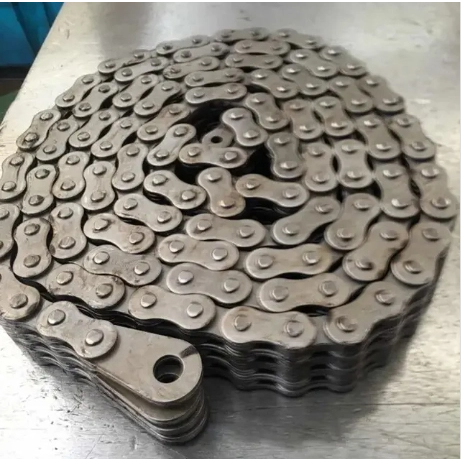
A leaf chain, also known as a leaf chain, is constructed from multiple layers of metal plates (leaves) connected by steel pins. This laminated design provides a large cross-sectional area to handle immense tensile (pulling) forces without stretching or breaking. Its simplicity is its strength—there are no small rollers or bushings that could fail under extreme direct tension. - Ultra-High Tensile Strength: Superior resistance to pulling forces.
- Durability in Demanding Environments: Robust construction withstands shock loads and harsh conditions.
- Compact Design: Provides high strength in a relatively narrow width.
- Typical Applications: Any application where the main requirement is to lift, hold, or pull a heavy load. Common uses include the lifting mechanisms of forklifts and construction cranes, the extension arms of hydraulic cylinders, and heavy-duty tensioning devices.
How to Choose the Right Chain for Your Application?
Ask yourself these key questions:
What is the primary action?
If the answer is "to drive a sprocket and turn a shaft," you need a Roller Chain.
If the answer is "to lift a load or provide a linear pulling force," you need a Leaf Chain.
- What is the direction of the main force?
- Roller Chain: Handles torque and rotational force.
- Leaf Chain: Handles straight-line, static, and dynamic tension.
Critical Warning: Using a roller chain in a heavy-duty lifting application it was not designed for is extremely dangerous and will likely lead to chain failure, catastrophic equipment damage, and serious injury. Always specify the chain type based on its engineered purpose.
Jinqiu Chain: Your Expert Partner for Both Solutions
As a leading manufacturer with over 36 years of experience, Jinqiu Chain provides both high-quality roller chains and specialized leaf chains (including the robust LL Series) for industries worldwide. For Roller Chains: We offer standard A and B series chains, along with custom-engineered solutions for specialized conveyor and drive systems.
For Leaf Chains: Our leaf chains, like the LL2088, are manufactured from high-tensile alloy steel and undergo rigorous heat treatment and testing to ensure they meet the demanding requirements of lifting and tensioning applications.
Still unsure which chain is right for your project? Our technical experts are here to help you make the correct choice.
Contact us today for a free consultation or to request a quote. Explore our full range of leaf chains to find the perfect solution for your heavy-duty needs.


